
A Living Masterpiece: 100 Years of Monet’s Garden in Giverny
In 2026, the world turns its gaze once again toward a small village in Normandy—Giverny—to commemorate the centenary of the death of Claude Monet. But this anniversary is more than a remembrance of an artist; it is a celebration of a place where art, nature, and time have fused into something extraordinary: Monet’s garden.
A hundred years after Monet’s passing in 1926, his garden continues to bloom—not just with flowers, but with meaning. It stands as one of the rare sites in the world where the boundary between creation and creator dissolves. Unlike a painting confined to a frame, Monet’s garden is alive. It grows, changes, and breathes, just as it did when he first imagined it.
This is the story of that garden—its origins, its evolution, and its enduring power as we mark its 100th anniversary.

When Monet arrived in Giverny in 1883, he was already an established artist—but not yet the legend we know today. The house he rented (and later bought) came with land, but not with the vision that would define it. That vision came from Monet himself. He lived in Giverny for 43 years, from 1883 until his death in 1926, dedicating much of that time not only to painting but to gardening. His approach was anything but casual. Monet treated the land as a canvas, carefully composing light, texture, and seasonal rhythm.
He began with the Clos Normand, the flower garden in front of the house. Rather than following traditional French garden design—with symmetry and strict geometry—Monet broke the rules. He planted flowers densely and freely, allowing them to spill into one another in waves of color. Tulips in spring, irises in early summer, sunflowers later on—each bloom was chosen with painterly intention. Gardening became, for Monet, a parallel art form. He studied plant catalogs, visited botanical exhibitions, and experimented endlessly. In many ways, the garden was not separate from his art—it was his art.
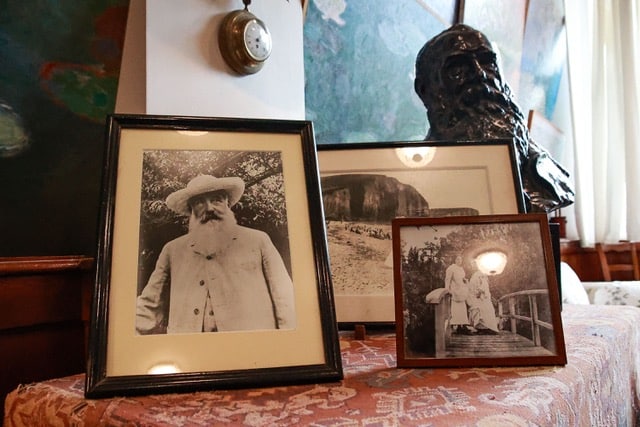
The Water Garden: A Japanese Dream in Normandy
In 1893, Monet expanded his vision. He purchased land across the road and diverted a branch of the Epte River to create what would become the most iconic part of the estate: the water garden. Inspired by Japanese aesthetics—especially ukiyo-e prints he collected—Monet designed a tranquil pond framed by willows, bamboo, and flowering plants. At its center stood the now-famous Japanese bridge, draped in wisteria.
Here, Monet found his greatest subject: water. Not water as a static object, but as a mirror of light, sky, and time. The pond became the basis for his monumental Water Lilies series—paintings that would redefine modern art. The garden itself became a laboratory of perception. Reflections blurred boundaries between above and below, between real and imagined. As Monet once suggested through his work, what we see is never fixed—it is always shifting with light and atmosphere.


The Garden as a Living Art
To understand Monet’s genius, one must understand that he did not simply paint nature—he constructed it. He arranged flowers by color harmony and bloom timing, ensuring that the garden would offer visual richness from early spring to late autumn. The result was a constantly evolving composition.
Visitors today often remark that walking through the garden feels like stepping inside a painting. That sensation is no accident. Monet intentionally designed the garden to be experienced from specific viewpoints—like a series of living canvases. The famous painting The Artist’s Garden at Giverny (1900) is not just a depiction of the garden—it is a translation of it. And the garden, in turn, was designed with painting in mind. This reciprocal relationship—garden shaping art, art shaping garden—is what makes Giverny unique.


From Private Sanctuary to Public Treasure
When Monet died in 1926, the garden faced an uncertain future. Without its creator, the delicate balance he maintained began to fade. Over time, the estate fell into disrepair. It wasn’t until decades later that restoration efforts began in earnest. The property, eventually entrusted to the Académie des Beaux-Arts, underwent extensive reconstruction. By 1980, the house and gardens were reopened to the public after a major restoration project.
The goal was not merely to preserve the site, but to recreate Monet’s vision as faithfully as possible—down to the arrangement of flowerbeds and the placement of the Japanese bridge. Today, the Fondation Claude Monet oversees the estate, maintaining it as both a museum and a living garden.

A Global Pilgrimage Site
Over the decades, Monet’s garden has become one of the most visited cultural sites in France, attracting hundreds of thousands of visitors each year. In 2026—the centenary year—the numbers are expected to surge even higher, with projections of around a million visitors. This popularity speaks to the garden’s universal appeal. It is not just for art historians or gardeners—it is for anyone who has ever been moved by beauty. Yet this success also brings challenges. Concerns about over tourism and preservation have grown, as the delicate ecosystem of the garden must withstand increasing foot traffic. The question facing Giverny today is one of balance: how to share this masterpiece with the world while protecting its essence.
The Art of Preservation
Maintaining Monet’s garden is no simple task. It requires not only horticultural expertise but historical sensitivity. Modern gardeners work to recreate the original plant varieties Monet used—some of which have become rare or extinct. The garden contains hundreds of thousands of plants, carefully cultivated to maintain the illusion of stepping into a Monet painting.
This is not preservation in the static sense. It is dynamic preservation—a continuous process of renewal. Each season, the garden is replanted. Each year, it changes slightly. And yet, it remains faithful to Monet’s vision. In this way, the garden embodies a paradox: it is both permanent and ephemeral.
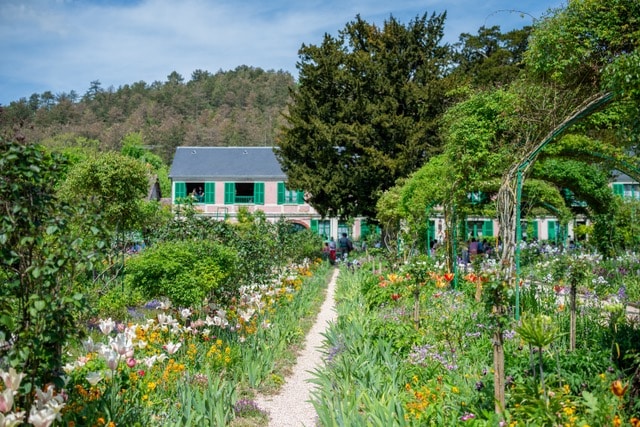
A century after Monet’s death, why does this garden continue to captivate? Part of the answer lies in its beauty. But beauty alone is not enough to sustain such enduring fascination.
Monet’s garden represents something deeper:
- The fusion of art and life – It dissolves the boundary between creation and environment.
- A new way of seeing – It teaches us to notice light, color, and fleeting moments.
- A model of sustainability – Long before the term existed, Monet was creating an ecosystem designed for continuous renewal.
It is also a reminder that great art is not always confined to museums. Sometimes, it grows under the open sky.


The Centenary
The 100th anniversary of Monet’s death is not just a commemoration—it is an invitation. An invitation to revisit the origins of Impressionism; to reflect on the relationship between humans and nature and perhaps most importantly, an invitation to slow down and observe. In a world increasingly dominated by speed and screens, Monet’s garden offers something rare: stillness. Yet it is not static stillness. It is a living, changing stillness—one that reminds us that time is always passing, and beauty is always fleeting.
Throughout 2026, France is marking the centenary of Claude Monet’s passing with an impressive lineup of exhibitions and cultural events across the country. In Paris, the Musée Marmottan Monet—home to the world’s largest collection of Monet’s works, with more than 100 paintings—holds particular significance this year, especially as it is scheduled to close for renovations in 2027. Meanwhile, the Musée de l’Orangerie is presenting a major exhibition titled Monet, Painting Time, exploring how his lifelong fascination with light and fleeting moments shaped his entire body of work. The Musée d’Orsay, which houses dozens of Monet’s paintings, has already contributed to the global celebration with an international exhibition launched in Tokyo. Back in Giverny, the Musée des Impressionnismes Giverny is showcasing Before the Water Lilies, an exhibition running through early July that focuses on Monet’s early years in Normandy, before he purchased his now-famous home.
Across the wider region, the Normandy Impressionist Festival will take place from late May through September, spanning cities such as Honfleur, Rouen, Le Havre, and Vernon, with around fifty contemporary art projects inspired by Monet’s gardens. The commemorations will conclude on December 5—the exact anniversary of his death—with a tribute held at his grave in Giverny.
A Garden Beyond Time
Inspired by that world of soft light, layered color, and natural movement, I set out to create a Wedding photo shoot that captured the same feeling—right next door at Le Dîme de Giverny. Rather than recreating the garden itself, together with a team, we used it as a starting point, translating its atmosphere into a wedding setting through florals, styling, and quiet, in-between moments. It became our way of continuing the story—taking inspiration from Monet’s garden and re-imagining it just steps away, in a space of our own at Le Dime de Giverny. You can explore this dreamy wedding shoot on my wedding blog, but here’s a glimpse.

Claude Monet once said that his greatest masterpiece was his garden at Giverny. Looking at it today, a century after his death, it is hard to disagree. Unlike his paintings, which hang in museums around the world, the garden remains rooted in one place. And yet, its influence extends far beyond its boundaries. It has inspired generations of artists, gardeners, and dreamers. It has shaped the way we see color, light, and nature. And it continues to evolve, season after season, year after year. In celebrating the 100th anniversary of Monet’s garden, we are not just honoring the past. We are witnessing the ongoing life of a masterpiece.
A masterpiece that blooms.
Vivre ma France,


2 Comments
Receive the news in your emailbox
If you like this articles , you can subscribe to our weekly newsletter.
Wonderful take on the region and Monet s gardens in Giverny. It’s inspiring and I would love to go there and explore. I loved reading about the history and also loved the idea of recreating the atmosphere and the essence of the place in a nearby garden.
Thank you Leo.
Anne,
Thank you so much for the lovely comment. We really should go together. Bises Leox