
The Art of Dressing a Queen: Discovering Queen Elizabeth II Through Fashion
There are exhibitions that display beautiful objects, and then there are exhibitions that tell a story. Queen Elizabeth II: Her Life in Style, currently on display at The King’s Gallery at Buckingham Palace, belongs firmly in the latter category. During a recent visit to London, I made my way to Buckingham Palace to see Queen Elizabeth II: Her Life in Style. As someone who has spent more than three decades designing events and admiring exceptional craftsmanship, I expected to see beautiful gowns. What I didn’t expect was to leave with an entirely new appreciation for how fashion became one of the Queen’s most powerful tools of communication.
Created to commemorate what would have been Queen Elizabeth II’s 100th birthday, the exhibition brings together more than 300 garments, accessories, hats, shoes, jewellery, original sketches, fabric samples and handwritten correspondence from the Royal Collection. Many of these pieces have never before been displayed publicly, making it one of the most significant fashion exhibitions ever assembled. As I wandered through the galleries, camera in hand, I found myself looking beyond the fabrics and embroidery. What unfolded before me was a fascinating journey through history, diplomacy, craftsmanship and design.


Following a Princess Through a Lifetime
The exhibition begins long before Princess Elizabeth became Queen. Visitors are introduced to Lilibet, the young girl who had no expectation of one day inheriting the throne. Seeing her childhood dresses, tiny shoes, ceremonial robes and family photographs immediately humanizes someone who has so often been remembered as an institution rather than a person.
Among the displays are beautifully preserved dresses from her early years, alongside personal keepsakes that reveal a glimpse of an childhood lived in extraordinary circumstances. It is a gentle introduction that reminds visitors that every remarkable life begins somewhere, and that before she became Queen Elizabeth II, she was simply a young princess growing up surrounded by family.
One of the strengths of the exhibition is its chronological layout. Rather than grouping garments by designer or style, the curators allow visitors to walk through the Queen’s life decade by decade. In doing so, you not only watch a young woman mature into a monarch, but you also witness the evolution of twentieth-century fashion itself.


The Wedding Dress That Inspired a Nation
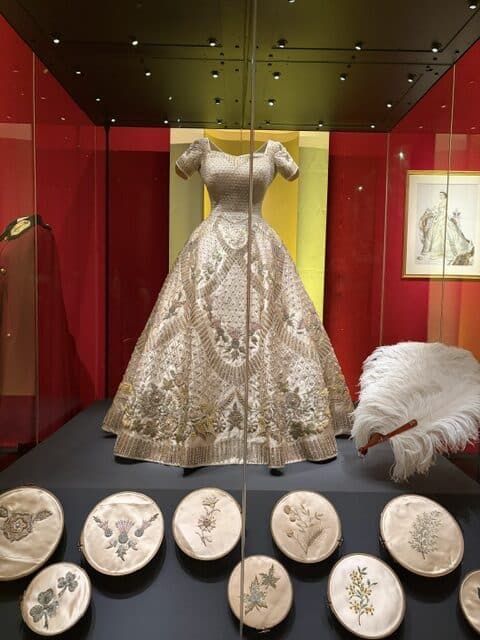
Without question, one of the exhibition’s centrepieces is Queen Elizabeth’s magnificent wedding gown, designed by Sir Norman Hartnell for her marriage to Prince Philip in November 1947.
Although I had seen countless photographs of the dress over the years, standing before it in person was something entirely different. The embroidery is astonishingly delicate, the proportions perfectly balanced, and the craftsmanship almost impossible to comprehend. Every tiny pearl, every embroidered blossom and every carefully stitched detail reflects hundreds upon hundreds of hours of work.
Its significance extends far beyond fashion. Britain was still recovering from the devastation of the Second World War, and clothing rationing remained in place. Princess Elizabeth herself famously used ration coupons towards the fabric for her gown, although many additional coupons sent by members of the public had to be politely returned because they could not legally be transferred. Hartnell drew inspiration from Botticelli’s Primavera, incorporating embroidered flowers representing hope, fertility and new beginnings. At a time when the nation desperately needed optimism, the dress became exactly that.
Standing before it, I couldn’t help but imagine the millions of people who saw those same embroidered flowers in newspaper photographs nearly eighty years ago. It wasn’t simply a royal wedding dress; it became a symbol of a country beginning to rebuild itself after years of hardship. The presentation itself is equally breathtaking. With the veil and crown appearing to float effortlessly above the gown, the display has an almost heavenly quality, allowing visitors to experience one of history’s most iconic wedding dresses in a way that is both elegant and deeply moving.

Fashion with Purpose
One of the greatest revelations of the exhibition is that Queen Elizabeth’s wardrobe was never simply about looking elegant. Every outfit served a purpose.
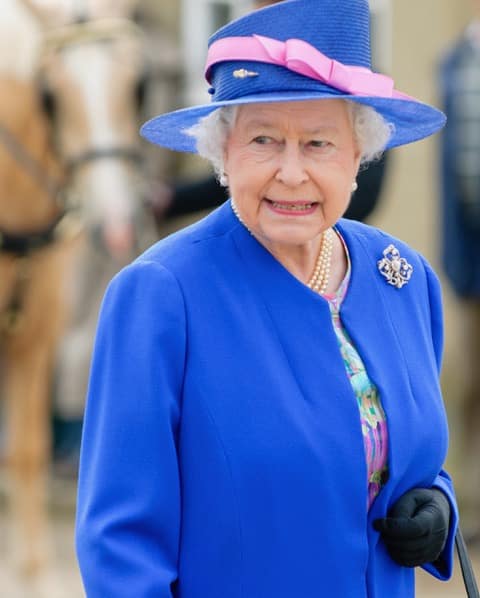
Every colour was carefully considered. Every hat, brooch, handbag and pair of gloves contributed to a carefully planned image. Rather than dressing to attract attention to herself, the Queen dressed so that others could easily see her. During walkabouts, thousands of people might spend hours waiting for just a brief glimpse of their monarch. Bright yellows, vivid greens, vibrant pinks, royal blues and rich purples ensured she could be spotted from remarkable distances.
Walking through the galleries, I couldn’t help noticing how carefully colour had been considered throughout her reign. It reminded me that whether you are designing a royal appearance or creating a wedding celebration, colour is never simply decorative. It creates atmosphere, evokes emotion and becomes part of the story people remember long after the event has ended.
Paris Couture Meets the British Monarchy
One aspect of the exhibition that particularly fascinated me was the subtle influence of the great Parisian fashion houses. Although Queen Elizabeth remained fiercely loyal to British designers throughout her reign, fashion has always been an international conversation, and the royal couturiers closely followed developments in Paris.
Following the Second World War, Paris once again established itself as the world’s fashion capital. In 1947, Christian Dior unveiled his revolutionary “New Look,” with its dramatically cinched waists, sculpted bodices and full flowing skirts. The collection transformed women’s fashion almost overnight, replacing the practical silhouettes of the war years with elegance and femininity.
Its influence is unmistakable throughout many of Queen Elizabeth’s early gowns. While Dior never dressed the Queen himself, designers such as Norman Hartnell carefully studied the new Parisian silhouettes before adapting them for the British monarchy. Looking closely at several dresses on display, you can clearly recognize the graceful proportions and structured elegance that Dior popularized, interpreted in a way that remained unmistakably British.
The same can be said of Hubert de Givenchy. His philosophy of refined simplicity, impeccable tailoring and understated elegance quietly influenced many royal day dresses during the 1950s and 1960s. Later still, Yves Saint Laurent introduced a bold modernity to couture, experimenting with cleaner lines, confident colour palettes and sophisticated simplicity. British designers absorbed these international influences while ensuring that the Queen’s wardrobe remained appropriate for her constitutional role.
The result was remarkable. Queen Elizabeth always appeared contemporary, yet she never appeared fashionable in the fleeting sense of the word. Her wardrobe evolved naturally with the times while maintaining the dignity and consistency expected of a monarch.


The Designers Who Shaped a Queen
No individual influenced the Queen’s public image more profoundly than Sir Norman Hartnell. Best remembered for designing both her wedding gown and Coronation gown, Hartnell helped define the visual identity of Britain’s monarchy during the post-war years.
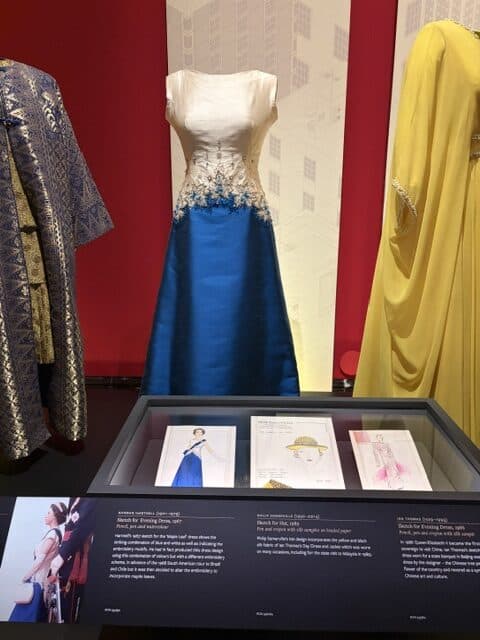
The exhibition displays many of his original sketches alongside completed garments, allowing visitors to appreciate the extraordinary journey from initial pencil drawing to finished masterpiece. Seeing the designer’s annotations and fabric samples beside the finished gowns offers a fascinating glimpse into the creative process. Every embroidered motif, every crystal and every carefully positioned seam reflects an extraordinary level of craftsmanship that has become increasingly rare today.
Later galleries introduce the work of Hardy Amies, who modernized the Queen’s wardrobe during the 1950s and 1960s with cleaner lines and simpler tailoring. Ian Thomas would continue that evolution in later decades, while preserving the elegance that had become synonymous with Queen Elizabeth. Each designer respected tradition while gently adapting it to changing fashions, ensuring that the Queen never appeared dated despite serving on the throne for more than seventy years.



More Than Evening Gowns
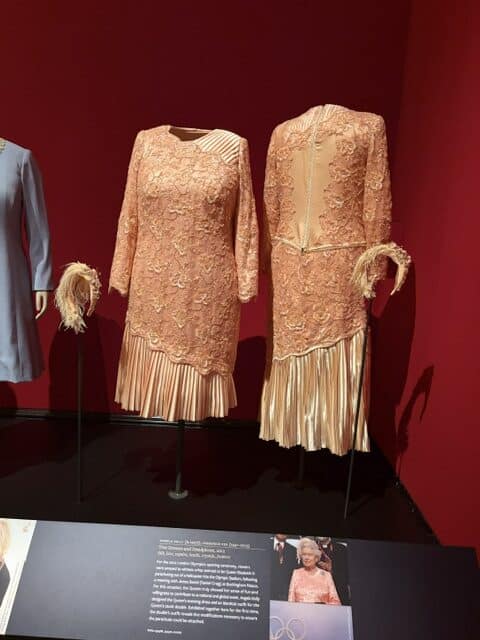
One of the pleasant surprises of the exhibition is its focus on the Queen’s everyday wardrobe. While the spectacular evening gowns naturally attract attention, there are also displays of riding jackets, country tweeds, tartan skirts, silk headscarves, practical walking shoes and tailored coats that reveal another side of Elizabeth.
These garments remind us that she was a woman who spent weekends in the countryside, enjoyed horse riding, loved walking her dogs and appreciated practical clothing every bit as much as ceremonial dress. Even these simpler garments display exceptional tailoring and attention to detail, demonstrating that elegance need not always be extravagant.
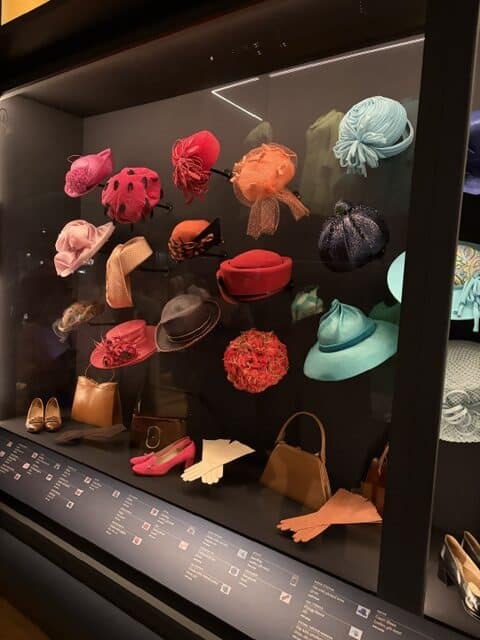
Nearby, displays of hats by milliners including Kate Day reveal the extraordinary craftsmanship involved in creating one of the Queen’s most recognizable signatures. A royal hat was never simply an accessory. It balanced the proportions of an outfit, complemented its colour palette and ensured the Queen remained instantly recognizable, even in the largest crowds.




The Extraordinary Craftsmanship
Perhaps what impressed me most throughout the exhibition was the craftsmanship itself.
Modern fashion often moves at extraordinary speed, with trends appearing and disappearing within months. Walking through these galleries offers a reminder of a very different approach to clothing. Every gown represents hundreds, and sometimes thousands, of hours of work by embroiderers, seamstresses, pattern makers, textile specialists and designers.
Standing just inches away from garments created more than seventy years ago, I found myself studying the hand stitching, intricate beadwork and extraordinary embroidery. Photographs simply cannot capture this level of detail. These garments are works of art as much as they are articles of clothing.
There is also something reassuring about seeing craftsmanship celebrated in an age increasingly dominated by fast fashion. These pieces were designed not for a single season, but for history itself.

Lessons Beyond the Palace
As I walked through the final galleries, I found myself reflecting on how much thought had gone into every public appearance Queen Elizabeth ever made. Nothing was accidental. Every colour, silhouette, fabric and accessory contributed to a carefully considered visual identity that remained remarkably consistent throughout her seventy-year reign.
As someone who spends much of his professional life designing weddings and events throughout France, I couldn’t help drawing parallels with my own work. Great event design isn’t simply about creating something beautiful. It is about telling a story through colour, texture, proportion and atmosphere. Guests may not consciously remember the exact shade of the linens or the variety of flowers in a centrepiece, but they remember how those elements made them feel.
The Queen understood that instinctively. Her wardrobe became an extension of the monarchy itself—recognizable, reassuring and timeless. In many ways, the same principles apply whether one is designing a royal state banquet or an intimate château wedding in the French countryside. The details matter because they shape the entire experience.
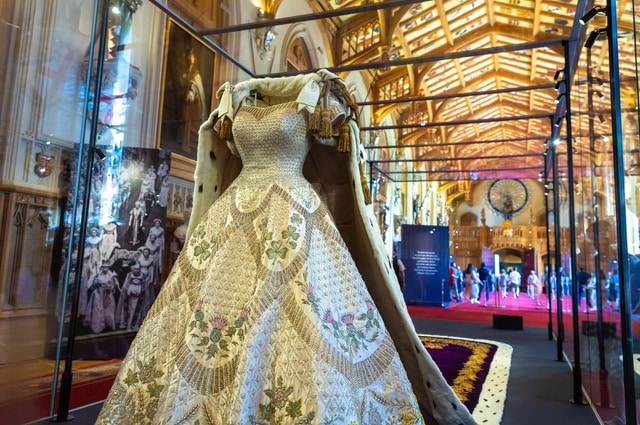
Although not part of Queen Elizabeth II: Her Life in Style at Buckingham Palace, no discussion of the Queen’s wardrobe would be complete without mentioning her magnificent Coronation Gown. Now displayed at Windsor Castle, the gown was also designed by Sir Norman Hartnell for the Coronation on 2 June 1953 and is widely regarded as one of the greatest achievements of twentieth-century couture. Richly embroidered with gold and silver thread, pearls, sequins and coloured silks, the dress is adorned with the floral emblems of the United Kingdom and the Commonwealth, including the Tudor Rose of England, the Scottish Thistle, the Welsh Leek, the Irish Shamrock, Canada’s maple leaf, Australia’s wattle, New Zealand’s silver fern, South Africa’s protea, India’s lotus flower and Ceylon’s (now Sri Lanka) lotus. Every motif was carefully chosen to symbolize unity across the Commonwealth, transforming the gown into far more than ceremonial attire—it became a powerful statement of duty, continuity and national identity. Having had the opportunity to see it during an earlier visit to Windsor Castle, I can honestly say it is every bit as breathtaking as the Queen’s wedding dress, and together they stand as two of Norman Hartnell’s greatest masterpieces.
Leaving Buckingham Palace, I found myself thinking less about royalty and more about craftsmanship, creativity and the remarkable designers whose work quietly helped define Britain’s image for generations. The exhibition succeeds because it is not merely about beautiful dresses. It is about the extraordinary partnership between a monarch and the talented couturiers, embroiderers, milliners and artisans who understood that clothing could communicate dignity, stability and national identity without saying a single word.
I arrived expecting to admire a collection of magnificent gowns. I left with a much deeper appreciation of the artistry, symbolism and thought behind every garment. In an age of disposable fashion and rapidly changing trends, Queen Elizabeth II: Her Life in Style is a reminder that true elegance is timeless. It is built on exceptional craftsmanship, thoughtful design and an understanding that the finest clothes do far more than make us look beautiful—they tell our story.
If you’re planning a visit to London, I cannot recommend this exhibition highly enough. Queen Elizabeth II: Her Life in Style is on display at The King’s Gallery, Buckingham Palace, and due to its overwhelming popularity, it has been extended until 18 April 2027. Tickets should be booked well in advance through the official Royal Collection Trust website, where you’ll also find opening times, admission prices and visitor information. You can reserve your tickets here: Royal Collection Trust – Queen Elizabeth II: Her Life in Style.
As I stepped back out into the gardens of Buckingham Palace, I couldn’t help but think that this exhibition wasn’t really about clothes at all. It was about craftsmanship, purpose, and the remarkable ability of great design to tell a story without saying a word. Whether dressing a Queen or designing a wedding, the principle is exactly the same: every detail matters. For anyone who loves fashion, history, design, or simply appreciates exceptional artistry, Queen Elizabeth II: Her Life in Style is one of London’s finest cultural experiences. It offers an intimate glimpse into the life of a remarkable woman whose wardrobe became part of the visual history of the twentieth century, leaving visitors with a simple but enduring reminder: at its very best, fashion is never just clothing. It is history, woven into fabric.
Life is richer when we take the time to appreciate beauty, history, and exceptional craftsmanship. Thank you for joining me on another adventure. Until next time… À bientôt!
Vivre ma France,


Receive the news in your emailbox
If you like this articles , you can subscribe to our weekly newsletter.